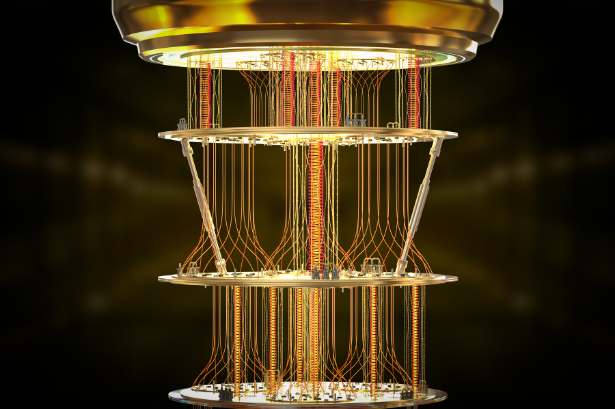

For years, quantum computing has been one of the more arcane pursuits of computer scientists and theoretical physicists. Now, it is no longer a theoretical field but one that has an increasing number of practical applications.
McKinsey found that quantum computing companies generated more than $1bn in revenue worldwide in 2025 and predicts that will rise to $4.4bn by 2028. The consulting firm estimates that quantum computing could deliver up to $2.7trn in economic value by 2035.
That’s leading to unprecedented levels of investment. According to research from PitchBook, quantum computing companies raised a record $3.9bn in VC funding during 2025, with giants of the tech and finance worlds like Nvidia, BlackRock and JPMorgan joining in the rush to invest in this breakthrough technological paradigm.
But is this money well spent – or is quantum computing a beautiful distraction that will ultimately never be practical to deploy at scale?
For all its promise and potential, quantum computing is still not feasible in everyday settings. While its practical applications are growing, they are still largely confined to specific use cases. The field still faces key technological hurdles that mean most of us aren’t likely to have a quantum computer in our home or our office any time soon.
There is disagreement between experts in terms of how far away utility-scale quantum computing is – or even whether or not it will ever be achievable.
Before looking into these arguments, though, let’s zoom out and establish exactly what quantum computing is.
What is quantum computing?
Quantum computing is a computing paradigm based on the quantum bit – usually shortened to ‘qubit’.
Classical computing is based on digital bits, and these can only ever have a value of 0 or 1; they are the building blocks of binary code.
Qubits, though, have a property called superposition, meaning they can exist in multiple states simultaneously. That means they can have a value of 0, 1, or both at once.
Qubits can also become entangled. Entanglement is when one qubit’s state depends on that of another, however much distance exists between them – which means that qubits could hypothetically exchange information across vast expanses of space instantaneously.
If that concept blows your mind, you’re not alone: Albert Einstein once referred to quantum entanglement as ‘spooky action at a distance’.
These properties mean that quantum computers can potentially solve some problems and challenges substantially faster than classical computers – with profound implications for all sorts of industries.
They could be used, for example, to rapidly model the interaction of molecules and pathogens to accelerate drug discovery, or to optimise power allocation across continental energy grids.
Aerospace manufacturer Airbus envisages quantum sensors providing pinpoint information on acceleration, rotation rates, electric and magnetic fields as well as temperature in order to improve the navigation of its aircraft.
It is this promise that is driving heightened levels of investment.
In June, Oxford Quantum Circuits (OQC) raised a £260m series C funding round – Europe’s largest ever for a quantum computing company.
But can sums like this pay off in the long run, or is quantum computing a flashy distraction?
What are the criticisms and drawbacks of quantum computing?
Quantum computing has a lot of potential, but the underlying technology has not yet developed to the point of delivering on this promise. It poses a thorny set of technical and economic challenges that severely limit its current use cases.
For one thing, it’s hugely expensive. Quantum computers have to operate under extreme refrigeration for the qubits to function properly.
Even in perfect conditions, the slightest interference – such as vibrations – can lead to quantum computers making errors.
Challenges like these have led some scientists to argue that quantum computing can never reach a scale of economic viability.
Mathematician Gil Kalai has suggested that quantum computation is impossible at scale because if you are dealing with a significant amount of qubits, the ‘noise’ (errors) that inevitably occur, even if only at tiny percentages, would correlate with each other and undermine the results.
Companies like Riverlane, based in Cambridge, UK, are attempting to overcome this major challenge of quantum computing by engineering quantum error correction (QEC) technology).
Correcting these quantum errors in real-time can, it believes, accelerate the pathway towards utility-scale quantum computing by 3-5 years.
As well as those that argue quantum can’t ever work, there are also those who argue that it shouldn’t. There are some potentially malicious applications of quantum computing: some worry, for example, that it could one day be used by cyber criminals to decode encrypted security systems.
Could quantum computing become a breakthrough paradigm?
It’s fair to say, though, that scientists arguing that quantum computing can never or will never work are in the minority.
Others are far more optimistic. Amazon AI executive Peter DeSantis, for example, recently told CNBC that the first “commercially useful” small-scale quantum computers could be with us within five to seven years.
Progress is being made towards this goal all the time.
In June, Nu Quantum, a quantum start-up based in Cambridge, announced a partnership with Colorado-based Atom Computing that they expect to build the hardware underpinning utility-scale neutral atom quantum computers.
“The future of quantum computing depends on distributed architectures capable of scaling beyond single QPUs to deliver real-world utility and meaningful commercial impact,” said Dr Carmen Palacios-Berraquero, CEO and Founder of Nu Quantum. “We are excited to launch this substantive technical collaboration and solve together some of the most challenging problems on the path to fault tolerance.”
The reality of quantum probably lies somewhere between what the extreme optimists and naysayers predict. We might well be decades away at least from quantum-powered computers being in everyday use, if that ever is the case – but we might see significant advances in quantum computing’s abilities and applications before then.
William Oliver, director of MIT’s Center for Quantum Engineering, told the university’s Data Center Day last year that “advancing from discovery to useful machines takes time and engineering, and it’s not going to happen overnight.
“But you’ve got to be in the game to play, and getting in the game is happening right now with quantum.”